GEO will change the way we think about digital visibility. If organic traffic becomes more branded and users pre-decide, your brand will be affected by generative search without a strategy in place.
This guide will explain what GEO is, how it works, what affects your content’s performance in AI-generated responses, and what your brand needs to do to become visible in generative searches.
The Search Behaviour That Has Given Rise to GEO
Generative search changes every stage of the classic search funnel. When a user poses a question to Google AI Overview, ChatGPT, Perplexity, or Microsoft Copilot, the AI does not return links. It provides a complete answer to the user’s question without requiring the user to visit any websites and assemble a coherent response from multiple sources.
For brands that are built on organic traffic generated by content, this is not a temporary fluctuation. It is a structural change.
What Is Generative Engine Optimisation (GEO)?
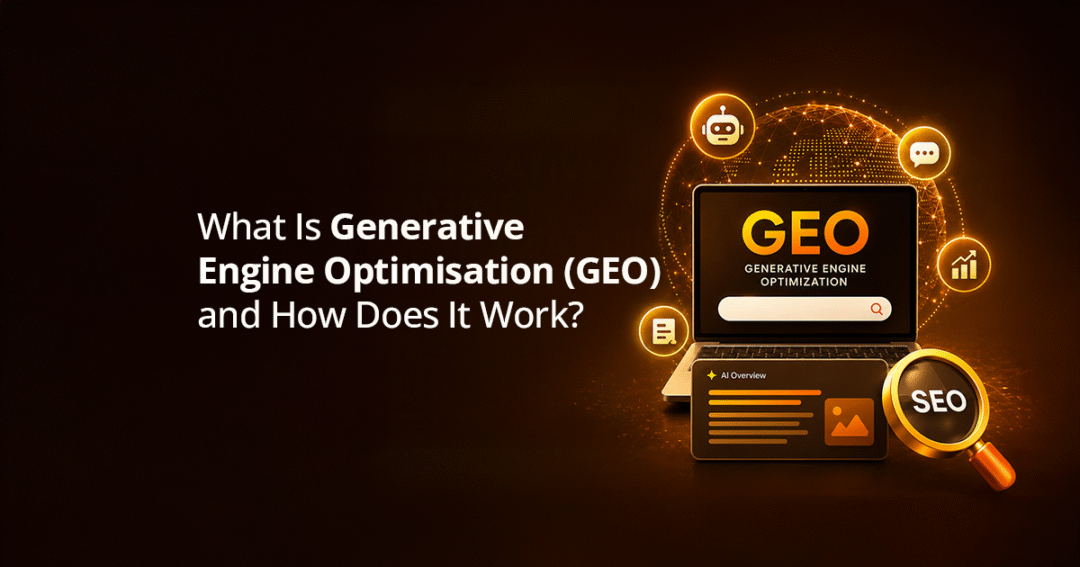
Generative Engine Optimisation (GEO) is the process of optimising your brand’s content, brand authority, and digital presence so that it is cited, referred to, and recommended by AI-powered generative search engines when providing answers to user queries.
GEO targets the creation of credible, well-structured and authoritative content. From “rank on page one” to “cite in your answer”.
GEO platforms:
- Google AI Overviews (former name: Search Generative Experience)
- Perplexity AI is the fastest-growing AI search engine worldwide
- ChatGPT with web browsing (OpenAI)
- Microsoft Copilot (Bing and GPT-4)
- Gemini with Search (Google DeepMind)
- Claude with Projects (Anthropic)
How Generative Search Engines Work (Technical Overview)
Understanding GEO requires some basic understanding of how AI search engines work.
Step 1: Query understanding
When a user enters a query into a search engine, the AI performs a deep semantic analysis of their intent, context, and the type of answer they need (comparative, explanatory, or recommendation).
Step 2: Information Retrieval
The AI retrieves one of two types of knowledge:
parametric – information encoded in the model weights during its training, and valid until the model’s training cut-off date.
Retrieved – current knowledge in “search-enabled” AI systems, such as Perplexity and ChatGPT, that browse the web for current information.
Step 3: Synthesis and generation
The AI selects sources, retrieves information, and generates the answer in natural language, using the GEO strategy as a key element of the process.
Step 4: Citation and Attribution
The citation process makes the brand more visible and credible, as the user might search for the cited brand after getting familiar with it in AI answers. The AI systems that make citations:
- Perplexity AI cites the sources together with the answers
- Google AI Overview – cites or doesn’t cite sources depending on the type of query
- ChatGPT with web browsing shows the URLs when the AI cites real-time content.
What Makes Content GEO-Optimised?
According to our research on citation patterns in generative searches, there are common characteristics of content that AI systems tend to cite. They are as follows:
1. Factual Precision and Accuracy
AI systems favour content that is precise and backed by reliable facts. If your site says “digital marketing is very important for brands these days”, it is too vague, and the AI will not cite your content. Instead, use the specific numbers such as “brands that publish over 16 blogs a month get 3.5 times more traffic than others”
GEO action: Always cite your claims in the content with reliable sources. From recent searches, studies or surveys.
2. Comprehensive topical coverage
AI systems thoroughly evaluate the page content to ensure the topic is covered comprehensively before the citation. A 600-word blog post that covers five points on the topic superficially will lose to a 2,500-word, elaborate guide that covers one topic in great depth.
GEO action: Create content clusters around the core topics. Pillar + spoke approach – create the content as a whole guide supported by a few sub-topics elaborated articles in order to make the AI system understand your authority.
3. Structured content format
AI systems have a strong bias towards structured content for information extraction. Always make sure that your content is structured as:
- Numbered lists and step-by-step procedures: AI systems often reproduce verbatim the structured lists of information.
- Comparison tables: for the commercial intent queries
- Definition blocks: “What is X” definition
- Key points bolded: as it allows AI systems to spot the key claims in the passage.
- FAQ section: It directly answers the conversational queries handled by the generative AI.
4. Strong E-E-A-T Signals
Generative engines evaluate Experience, Expertise, Authoritativeness, and Trustworthiness through:
- Authorship and credentials. The post written by “Priya Sharma, 12 years in performance marketing” is more citable than one without an author.
- Date of publication and freshness: AI systems heavily discount outdated content and favour the recent one
- Links to credible sources. Links to authoritative research prove that the content is based on facts and backed by evidence.
- Backlinks from credible sources. Backlinks from the high-authority sites linking to your content prove that you are credible in the eyes of other sources.
- Brand reputation signals. Mentions in the Wikipedia, industry publications, press releases, and review platforms
5. Conversational Query Alignment
Generative AI handles conversational, long-tail and question-based queries much better than traditional search engines. GEO-optimised content anticipates these conversational queries and answers them.
Traditional SEO keyword: “SEO agency in Mumbai“
GEO-optimised query: “Which digital marketing agencies in Mumbai specialise in SEO for e-commerce brands?”
Creating content that answers these more elaborate queries in natural language will considerably improve citation chances.
6. Unique insights and perspective
All the AI systems are trained to avoid repetitive and derivative content. If your article repeats the information found in the top 10 Google search results, it adds no additional value to the AI’s knowledge base and is less likely to be cited.
GEO action: Always add something unique (be it survey data, client cases, or internal benchmarks) to the content,, as unique data is disproportionately valuable to the AI.
GEO vs SEO: The Core Differences
| Dimension | Traditional SEO | Generative Engine Optimisation (GEO) |
| Target audience | Search engine algorithms | AI language models and retrieval systems |
| Success metric | Rankings and organic clicks | Citation frequency in AI responses |
| Content format | Keyword-rich pages | Structured, factual, comprehensive content |
| Link importance | Central backlinks drive rankings | Indirect links signal credibility to AI |
| Brand visibility | Requires the user to click | Achieved even with zero clicks (branded mentions) |
| Time horizon | 3–12 months | 6–18 months for consistent citation |
| User interaction | User reads your page | AI reads your page; user reads the AI’s summary |
How to Measure Your GEO Performance
GEO measurement is not as advanced as SEO analytics yet, but here are the methods available in 2026:
Manual citation tracking: You should regularly ask Perplexity, ChatGPT with web browsing, and Google AI Overviews for your category’s most important questions. Measure whether AI cites the brand or the content.
Trends in branded search volume: GEO-discovery often leads to branded search. An increasing number of “DigiChefs digital marketing” searches may mean that you are being cited by AI, even though you cannot measure it directly.
Traffic from AI in GA4: Google Analytics 4 captures the referrals from AI platforms. You can track the referrals from perplexity.ai, chat.openai.com and bing.com/chat.
Share of voice in AI responses: There are tools like Profound, Otterly.ai, and AI tracking in Semrush that measure your brand visibility in AI-generated responses.
A Practical Approach to GEO Strategy: Where to Start
If you are building your GEO approach from scratch, here is the recommended sequence of actions:
- Month 1-2: Content audit and gap analysis: Try to identify the most commercially important topics for your brand. For each topic, test the current AI responses to find out which brands are cited. Find the gap between the current AI representation of your category and your brand.
- Month 2-4: Content depth upgrade: Upgrade your high-priority articles in terms of GEO requirements: add facts, statistics, structure with the author credentials and clear definitions of the topics. Make sure that your thin content (under 1,000 words with poor factual density) is upgraded or merged with related articles.
- Months 4-6: Building topical authority clusters: Develop a cluster of 5 to 10 articles for each core topic: keep one main guide on the topic and a few related articles on the subtopics. Consistent brand presence across multiple AI systems for related queries will increase titration frequency.
- Month 6+: Building the authority signals: Do the digital PR and get quoted in industry publications. Update your Wikipedia pages whenever possible. Have a strong presence on LinkedIn, G2 and Clutch.
The Bottom Line
Generative Engine Optimisation (GEO) is becoming not only a new concept but also an indispensable strategy for all brands that rely on content for lead generation and to build authority. With the increasing popularity of AI search, all brands that don’t implement GEO will disappear from many potential customers’ view.
The good news: Maintaining the depth, accuracy, structure, and genuine expertise of your content becomes the hallmark of great content. GEO simply makes these qualities algorithmically measurable and commercially consequential.
Start by testing how AI systems currently represent your brand and category. Then build the content, authority, and structure that earn your place in those AI-generated conversations.
Frequently Asked Questions
- Is GEO the same as SEO?
No, the foundational principles of GEO and SEO are the same, but both serve different purposes in digital marketing. SEO optimises for ranked links in traditional search results and measures success in clicks and traffic. GEO optimises for citations in AI-generated responses, where success is measured in how often AI systems reference your brand and even when no click occurs. Both are necessary in 2026. - How does GEO affect zero-click searches?
GEO directly addresses zero-click search, the growing phenomenon in which users get answers from AI without visiting any website. Zero-click search hurts traffic volume for traditional SEO, but GEO turns it into a brand-visibility opportunity. When a brand is cited in an AI’s response, it creates brand awareness and often drives downstream branded searches. - How long does GEO take to show results?
GEO shows results faster than traditional SEO in some respects. High-quality and well-structured content appears in AI-generated responses within weeks of publication, especially on platforms like Perplexity. But building consistent, broad citations across other AI platforms typically takes 6–12 months of sustained effort. - What types of content are most often cited in AI responses?
AI systems most frequently cite: definitive how-to guides, statistical data and research-based summaries, definition-led explainers, and expert opinions from credible named authors. - Can small brands compete in GEO?
Yes, often more easily than in traditional SEO. GEO rewards content quality and topical depth over pure domain authority. A smaller brand that publishes the most comprehensive and well-structured, and factually precise content on a specific topic can out-cite a larger brand with weaker content in AI responses.