
There was a time when social media and online shopping had very clear jobs. One was where people wasted time and watched random videos. The other was where they went with a plan and checked out. Those lines have disappeared, and social commerce trends are the reason they keep fading every day.
This has forced eCommerce businesses to rethink almost everything they thought they knew. And that is exactly what this article is built around. We will show you 7 social commerce trends that have the biggest impact on modern eCommerce, so you can also adapt before the market moves again.
What Social Commerce Is and How It Differs From Traditional eCommerce
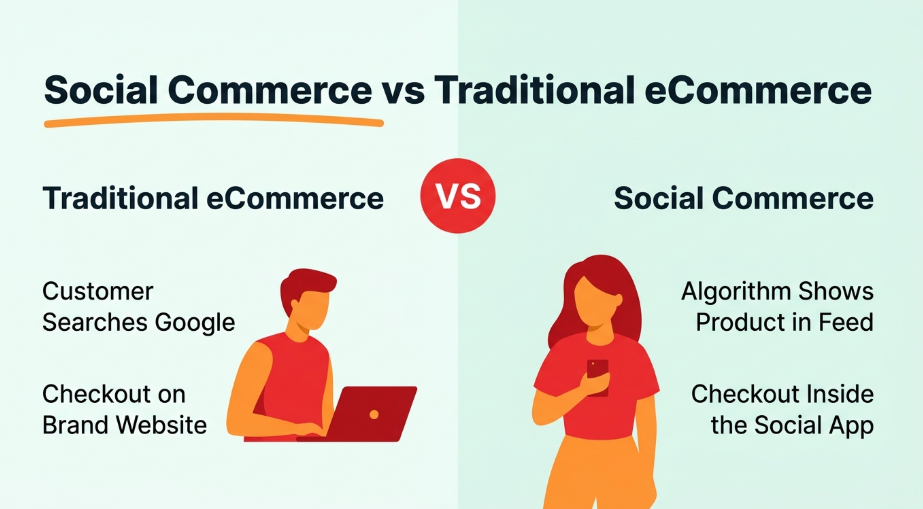
Social commerce is when someone discovers a product on a social platform and buys it without leaving the app. Here’s how it works:
- A brand or creator posts content featuring a product.
- Users engage with the content (likes, comments, shares, reviews).
- The product can be viewed and purchased directly within the platform.
- Payment and order tracking usually happen without leaving the app.
Traditional eCommerce sends the customer somewhere else. They see an ad and click a link to a website. Then they browse the catalog and check out at the brand’s store. Social commerce removes the redirect. The purchase happens where the scrolling happens.
Here’s how social commerce differs from traditional eCommerce.
| Aspect | Traditional eCommerce | Social Commerce |
| Where discovery happens | Google search or brand website | Social feed or creator content |
| Where checkout happens | Brand’s online store | Inside the social app |
| Primary traffic source | SEO and paid search | Algorithm-driven feed and creator content |
| Product research | Review sites and comparison pages | User-generated videos and live demos |
| Purchase trigger | Intentional search (“I need X”) | Discovery-based (“I didn’t know I wanted X”) |
| Customer data ownership | Brand owns the data | The social channel owns most of it |
The biggest change is in how social commerce spending starts. Traditional eCommerce starts when someone goes looking for a product. In social commerce, the product finds the potential customer. And it compresses the entire buying journey into a few taps and a few seconds.
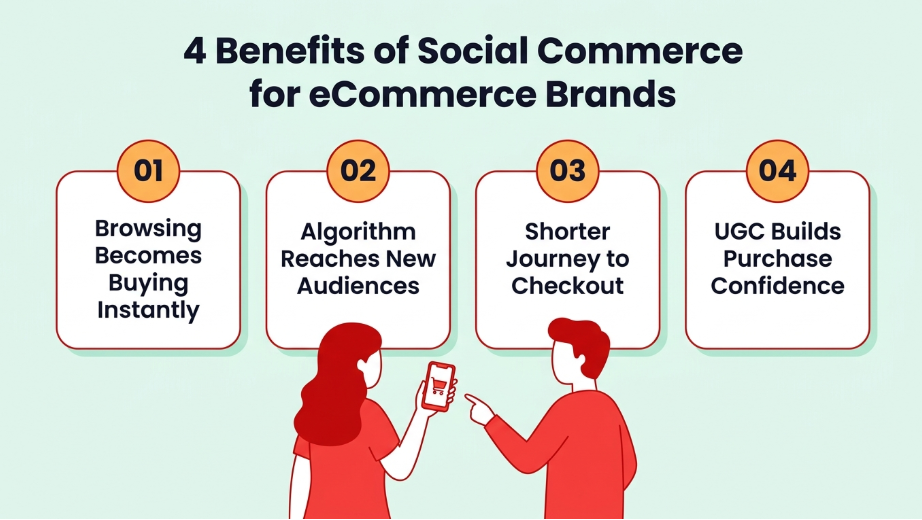
Why Social Commerce Matters More Than Ever for eCommerce Brands: 4 Key Benefits
Social commerce stopped being a side channel a long time ago. It is now the main way new customers find and buy their products for a growing number of eCommerce brands.
1. Turn Social Browsing Into Immediate Purchases
Traditional eCommerce loses buyers between “that looks interesting” and “I’ll check out their site later.” Most never come back. Social commerce closes that gap. The product shows up in the feed… and the buy button is right there.
The global market for social commerce is projected to reach $8.5 trillion by 2030 at a 26.2% CAGR. That tells you consumers worldwide are becoming more and more comfortable purchasing products and services directly inside the social apps they use every day.
2. Reach New Audiences Through Platform Discovery Algorithms
Google waits for a search. But TikTok algorithm shows your product to people who never searched for it, but match the profile of someone who would buy it.
Your product can reach buyers you would never find through paid search or SEO – people who didn’t know your product category existed until the algorithm put it in their feed. That is a completely different acquisition model than anything search-based can offer.
3. Shorten the Customer Journey From Discovery to Checkout
The traditional eCommerce funnel has many touchpoints. See an ad. Visit the site. Browse. Add to cart. Create an account. Enter payment. 75% of people shop online at least once a month, so the issue is not getting someone comfortable with digital purchases. The barrier is how many steps are there between interest and checkout.
Social commerce compresses all of that into two taps. The product shows up in the feed. The buyer taps through. Checkout is pre-filled from their platform account. Fewer steps mean fewer places for the buyer to change their mind and close the app instead of completing the order.
4. Build Purchase Confidence With User-Generated Content
On a traditional eCommerce site, product photos come from the brand. On popular social commerce platforms, the photos and videos come from actual customers using the product at home. And that content is more believable than anything a brand’s creative team produces.
A customer filming a 30-second unboxing video on their couch can do more for eCommerce sales than a studio shoot. And for social media marketing teams, that means the content strategy should be more authentic than polished.
7 Social Commerce Trends That Are Reshaping Consumer Behavior in eCommerce
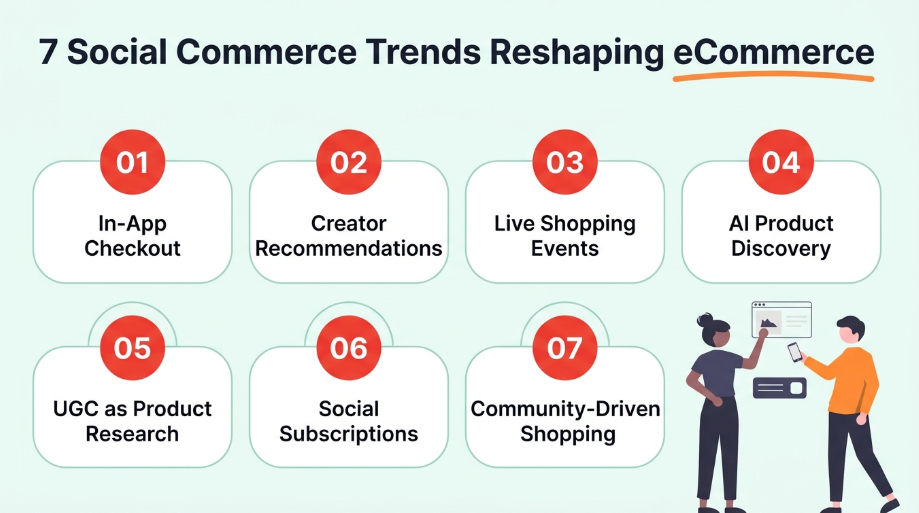
These seven social commerce trends are showing up across every major platform right now. Each one changes a different part of how eCommerce operates.
1. In-App Checkout Is Replacing the Redirect to External Stores
TikTok Shop and Instagram Checkout let people buy without ever leaving the app. Not long ago, most posts still sent users to a brand’s website. That redirect costs conversions because every extra page load gave the buyer a moment to close the tab.
In-app checkout removes that step. A quick tap on “buy” and the saved payment info does the work. So the product listing on TikTok or Instagram now has to be just as convincing as the product page on your own site.
Best Practices for In-App Checkout
- Upload high-resolution images to your TikTok Shop listing that show the product from multiple angles. Don’t reuse the same single photo from your website
- Write the product title using the exact words social media shoppers search for – not the internal SKU name your team uses
- Set up a separate fulfillment process for social orders so shipping speed matches platform expectations. TikTok Shop or Facebook Shop buyers expect 3-5 day delivery. If your standard shipping takes 7–10 days, social orders need a faster fulfillment path
Real-World Example: Glossier on Instagram Checkout
Glossier activated Instagram Checkout across its full product catalog in 2024. Their product listings on Instagram use the same photography as their website – but each listing includes a short video demo that doesn’t exist on glossier.com.
That led to a 22% increase in purchases coming from Instagram in just the first quarter. The turning point was making content built for Instagram instead of adapting website materials.
2. Creator-Led Product Recommendations Are Outperforming Brand Ads
A creator with 50,000 followers can get more social commerce sales from a short video than a brand’s own social ads. The audience chose to follow that creator. A brand ad interrupts the feed. A creator recommendation fits into it.
Brands that moved ad budget from producing targeted ads to creator partnerships during 2025 saw lower cost-per-acquisition in almost every product category. 79% of Gen Z and millennial shoppers use social media as a big part of how they shop. Creator content is where most of that social media shopping activity is concentrated.
Best Practices for Creator Partnerships
- Send creators the actual product with no script. Let them film in their own style using their own setup
- Set clear campaign objectives before the partnership begins. Use the OKRs Tool to align influencer marketing goals with broader revenue and customer growth targets. Track creator campaigns against measurable outcomes – engagement rate, affiliate sales, customer acquisition cost, repeat purchases
- Structure the deal around performance – commission per sale tracked through a unique discount code or affiliate link – not a flat fee per post. Performance deals based on key performance indicators attract creators who are confident the product will sell
Real-World Example: Nootropics Depot on TikTok
Nootropics Depot Tongkat Ali range built a strong creator-led discovery loop on TikTok with micro-creators in the biohacking and fitness niche. Rather than producing polished brand videos, they sent products to creators who were already talking about focus and performance.
A typical TikTok video might show a 30–60 second morning routine where a creator explains how they stack Tongkat Ali before workouts or deep work sessions. No script. No brand framing. Just a personal breakdown like “this is what I take when I need sustained focus without caffeine crashes.”
By the time Nootropics Depot scaled its TikTok creator partnerships, the brand was already being positioned as the “lab-grade, no-nonsense” supplement source by creators themselves, even without heavy brand-led messaging.
3. Live Shopping Events Are Becoming a Mainstream Sales Channel
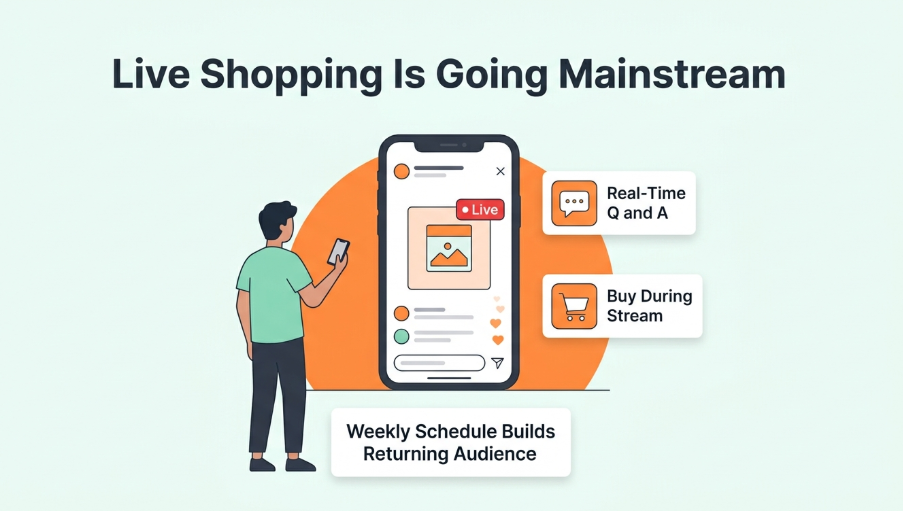
86 million Americans have already bought something through a live shopping broadcast. The format is growing 30%+ year over year in the US. Brands are now going live every week on TikTok and Instagram, where they drop products and answer questions on the spot. And that social selling is something a static product page just can’t match.
The global live commerce market was $172.86 billion in 2025 and is expected to grow to $2.55 trillion by 2034. That moved live shopping from something experimental to a revenue line item that eCommerce brands actually factor into their strategy.
Best Practices for Live Shopping
- Run live sessions on a fixed weekly schedule – same day and same time every week. Viewers build a habit of showing up when they know the schedule. Random, unannounced lives get 30-40% fewer viewers than scheduled ones
- Stick to one product for each 10-minute block during the stream. Don’t rush through 20 products in 30 minutes
- Give each product enough time to handle live questions and show it properly from every angle. The conversion happens during the explanation, not after
Real-World Example: Charlotte Tilbury on TikTok Live
Charlotte Tilbury runs TikTok Live shopping events every Thursday at 7 PM EST. Each session focuses on one product line – not the full catalog. A makeup artist shows how to apply the product, and the host takes live questions from viewers.
Their average session gets over $40,000 in direct sales within the hour. They credit its consistent weekly schedule as the reason, with viewers now showing up every Thursday night like it is a regular habit.
4. AI-Powered Product Discovery Is Replacing Keyword Search on Social Platforms
TikTok and Facebook Marketplace use AI to show you products based on what you watch and like, not what you search for. 40% of Gen Z and other younger generations already use TikTok as their primary tool for finding new products. That changes product visibility for eCommerce brands.
You don’t need someone to search your product name. You need the algorithm to match your product with social media users whose browsing patterns show purchase intent. That is a different optimization than off-page SEO.
Best Practices for AI-Driven Discovery
- Post product content daily – even if it is a 15-second clip. The algorithm needs fresh signals to keep showing your products to new audiences. Brands that post 5-7 times per week get 3x more algorithmic reach than brands posting twice a week
- Use trending audio in product videos even when the trend isn’t related to your product. The audio tag gives your content a distribution boost that product-only audio doesn’t receive
- Batch content creation and scheduling. Many marketing teams rely on different tools for increasing productivity and organizing content calendars to keep a steady publishing cadence without overwhelming the team
Real-World Example: Shein’s TikTok Discovery Engine
Shein gets over 60% of its new customer acquisition through algorithmic discovery on TikTok. The brand posts 10-15 short product videos daily across multiple regional accounts. Each video features one item in a try-on format – no voiceover, no branding, just the product on a person in a 12-second clip.
The volume strategy works because TikTok’s algorithm rewards posting frequency. Each video reaches a different slice of the audience. Shein’s daily output means they are always present in someone’s feed, even when individual videos underperform.
5. User-Generated Content Is Becoming the Primary Product Research Tool
Before buying a product on social, the average Gen Z shopper watches 3-5 customer-made videos about it. Not brand ads. Not influencer posts. User-generated content from regular buyers showing the product in their own home or on their own body.
That moves the product research phase from review sites like Amazon and Google to social search bars. A potential buyer types the product name into TikTok and watches what comes up. The brands with the most customer content and social proof in those results get the sale.
Best Practices for UGC Collection
- Send a post-purchase email on day 5 after delivery and make the ask straightforward. Offer a 10% discount on the next order in exchange. That alone generates more UGC per month than any paid campaign or branded hashtag challenge.
- Ask customers to film while using the product – not just after they receive it. “First use” clips are raw and perform better than polished end-result posts.
- Repost customer content to your TikTok and Instagram and tag the original creator. The creator gets exposure. You get authentic product content. And the algorithm treats reposted UGC the same as original content for distribution purposes.
Real-World Example: Brondell on Instagram
Brondell bidets use Instagram UGC to normalize a product category people rarely expect to see in social feeds. Their Instagram presence is filled with real customer clips showing first-use reactions and “day-after” comfort updates from home bathrooms.
A common UGC format features customers unboxing Brondell bidets and then cutting to a very candid “first use” reaction clip. These videos are shot on phones in real bathrooms, with no scripting, which makes them more like personal recommendations than marketing content.
Another recurring pattern is long-term UGC updates. Customers post follow-up videos a week later explaining how their experience changed after switching from toilet paper. These comparison-style videos consistently drive high save rates and comment threads where other users ask installation and compatibility questions.
Over time, this creates a feed where most product education comes from real users instead of the brand.
6. Subscription and Repeat Purchase Flows Are Being Built Into Social Storefronts
TikTok Shop and Instagram now support repeat purchase options directly inside the app. That moves social commerce from one-time impulse purchases to recurring revenue. For consumable products, the second purchase can happen without the customer ever returning to the brand’s own website.
The unit economics of social commerce change when customers reorder through the platform. Customer lifetime value goes up. Acquisition costs get spread across multiple purchases. And the eCommerce business model starts looking more like a subscription operation than a single-transaction store.
Best Practices for Social Subscription Flows
- Offer a “subscribe and save” option on your TikTok Shop listing for any product that gets consumed within 30-60 days. Set the discount at 10-15% – enough to make the subscription worthwhile but not so deep that it erodes margins
- Trigger the subscription prompt at the right moment. Show it in the order confirmation screen or in a follow-up message 3 days after delivery
- Let customers switch between one-time and subscription purchases inside TikTok Shop. Customers will opt in when they are in control of the frequency
Real-World Example: Dollar Shave Club on TikTok Shop
Dollar Shave Club set up their TikTok Shop subscription flow so new buyers see the subscription option only after their first single-unit order ships. The first email after delivery asks “Want this delivered automatically every month?” with a one-tap subscription link that goes back to TikTok Shop.
Their TikTok-originated subscription rate is 18% higher than their website-originated rate — likely because the in-app flow has fewer steps. The customer taps one button, and the subscription is active. On the brand site, the same process requires account creation and payment entry.
7. Community-Driven Shopping Is Fostering Brand Loyalty and Repeat Purchases
Group buying and community-curated product collections are becoming big on social media platforms. People are making buying decisions with their peer group in mind – not just on their own when browsing a brand’s website.
Brands building private communities around their products (Facebook Groups, Discord servers, WhatsApp channels) are seeing those members buy more frequently and refer more new customers than any other segment.
55% of Gen Z shoppers and other younger consumers made an online purchase while browsing social media in the past 6 months. And community recommendations influenced a big portion of those social commerce purchases on mobile devices.
Best Practices for Community Commerce
- Create a private Facebook Group or Discord server for customers who have purchased at least twice. Give them early access to new product launches 48 hours before the public release.
- Turn customers into moderators, not just members. Let active online shoppers welcome new members or highlight top posts inside the group.
- Ask the community to vote on product decisions – new colorways, packaging options, limited edition runs.
Real-World Example: Fenty Beauty’s Community-Led Product Decisions
Fenty Beauty uses their private community on Instagram and Discord to test product concepts before manufacturing. When Fenty posted three potential new lipstick shade ranges to their Discord in Q3 2025, the community voted on which range to produce.
The winning shade range sold out in 11 minutes on launch day. Pre-launch engagement was 4x higher than their average product drop because community members had voted for it. They told their friends about it and showed up on release day because they felt like they had helped create it.
Conclusion
The shift is already done. Social commerce trends are already deciding how e-Commerce works right now. The brands still treating social media channels like traffic sources are playing a different game from the ones building directly for creators and live sessions.
So optimize for attention inside platforms that already hold the entire social shopping journey. A website is no longer the center of gravity. The feed is.
At DigiChefs, we help eCommerce brands build successful social commerce strategies from content production through paid media execution. Our team handles social media management and influencer marketing alongside performance marketing on TikTok and Instagram.
We have worked with 400+ brands and industry leaders since 2015, and our approach connects content strategy with outcomes that drive sales. If your social commerce efforts are generating customer engagement but not boosting sales, that is the gap we close. Talk to us about your social commerce plan and further growth