
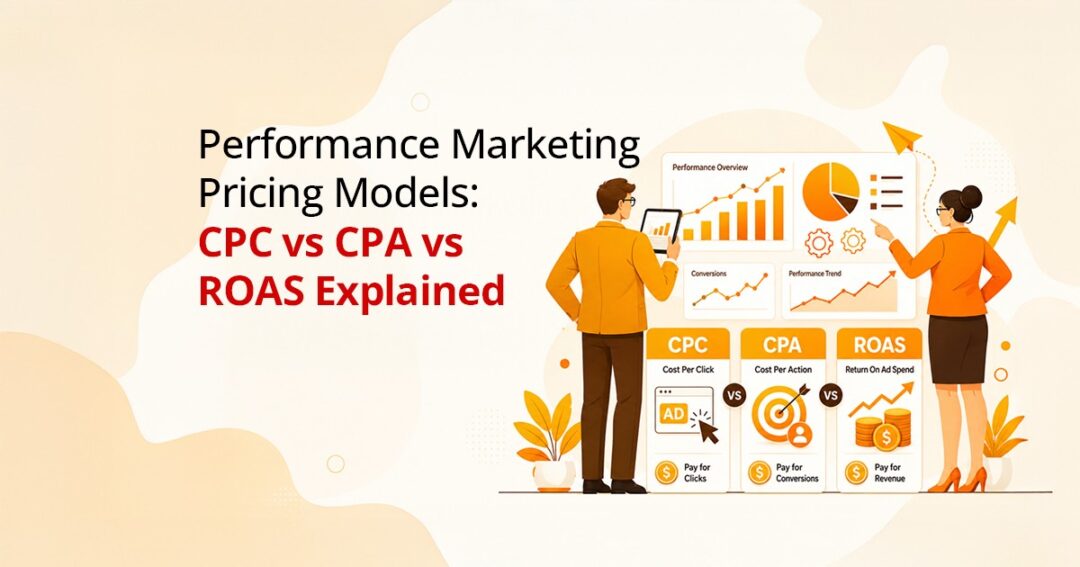
Performance marketing is all about results. But before you launch a campaign, there’s one important decision to make: how will success be measured?
Should you pay for clicks, conversions, leads, or revenue?
The answer depends on your business goals. Choosing the right pricing model can improve profitability, optimize budgets, and help you get better results from your campaigns. Choosing the wrong one can lead to wasted spend and misleading performance metrics.
Let’s break down the most common performance marketing pricing models and understand when each one makes sense.
Why Pricing Models Matter
Every pricing model influences how campaigns are managed.
For example, if you’re optimising for leads, your agency or platform will focus on generating more leads. If you’re optimising for revenue, the focus shifts towards driving sales value.
That’s why your pricing model should align with what your business actually wants to achieve.
The goal isn’t just better campaign metrics. It’s better business outcomes.
CPC (Cost Per Click)
CPC stands for Cost Per Click. As the name suggests, you pay every time someone clicks on your advertisement.
Formula:
Total Spend ÷ Total Clicks = CPC
This model is commonly used on Google Search Ads and other paid search platforms.
When CPC Works Well
CPC is ideal when you’re in the early stages of running campaigns and want to gather data.
It also works well if your conversion tracking is still being set up or if you want greater control over bids and budgets.
One advantage of CPC is that you only pay when someone engages with your ad. This makes it easy to measure the cost of bringing traffic to your website.
The Limitation of CPC
A click doesn’t guarantee a conversion.
You may generate thousands of clicks, but very few enquiries or sales. That’s why CPC should never be viewed in isolation. It needs to be connected to conversion data to understand its true value.
CPM (Cost Per Thousand Impressions)
CPM stands for Cost Per Mille, which means cost per thousand impressions.
With this model, you pay based on how many people see your ad rather than how many click it.
Formula:
(Total Spend ÷ Total Impressions) × 1,000 = CPM
When CPM Makes Sense
CPM is best suited for brand awareness campaigns.
If your goal is to increase visibility, launch a new product, or reach a large audience, CPM can be highly effective.
Platforms such as Meta Ads, YouTube, and programmatic display networks commonly use CPM pricing.
However, CPM is not the best option if you’re focused on direct conversions or lead generation.
CPA (Cost Per Acquisition)
CPA measures the cost to generate a specific action.
That action could be a lead, a demo booking, a sign-up, a purchase, or an enquiry.
Formula:
Total Spend ÷ Total Conversions = CPA
For many businesses, CPA is one of the most meaningful metrics because it focuses directly on outcomes.
Why Businesses Prefer CPA
Unlike CPC, CPA goes beyond traffic.
It tells you how much you’re paying for actual results. This makes it easier to evaluate campaign performance and communicate value to stakeholders.
For example, saying “We acquired 100 customers at ₹1,500 each” is far more useful than reporting clicks and impressions.
Where CPA Falls Short
Not all conversions are equal.
A campaign might generate a large number of leads at a low CPA, but if those leads are unqualified, the business still loses.
That’s why lead quality should always be considered alongside CPA performance.
ROAS (Return on Ad Spend)
ROAS measures the revenue generated for every rupee spent on advertising.
Formula:
Revenue Generated ÷ Ad Spend = ROAS
If you spend ₹1,00,000 on ads and generate ₹5,00,000 in revenue, your ROAS is 5x.
Why ROAS Is Popular
For e-commerce businesses, ROAS is often the most important metric.
It helps marketers understand whether advertising spend is actually generating revenue.
Unlike CPA, ROAS gives more weight to high value purchases. This allows campaigns to prioritise customers who are likely to spend more.
The Important Catch
Revenue and profit are not the same thing.
A campaign can achieve an impressive ROAS while still being unprofitable if margins are too low.
This is why many brands now look beyond ROAS and consider overall profitability when making decisions.
CPL (Cost Per Lead)
CPL measures the cost of generating a lead.
Formula:
Total Spend ÷ Total Leads = CPL
It’s widely used in industries such as B2B services, real estate, education, healthcare, and financial services.
The CPL Trap
A low CPL looks great on a dashboard.
But if those leads never convert into customers, the metric becomes meaningless.
Instead of focusing solely on CPL, businesses should also track lead quality and qualification rates.
A higher CPL with higher-quality leads often produces stronger business results than a lower CPL with lower-quality enquiries.
Which Pricing Model Should You Choose?
The right model depends on your business type and objectives.
For e-commerce brands: ROAS is usually the primary metric.
For lead generation businesses, CPA and CPL are often the most relevant.
For SaaS companies: CPA works well when tracking trials, demos, or sign-ups.
For brand awareness campaigns: CPM remains the preferred option.
There is no universal best model. The best choice is the one that aligns most closely with your business goals.
Final Thoughts
Performance marketing success isn’t just about creating great ads. It’s also about measuring the right outcomes.
CPC, CPM, CPA, ROAS, and CPL all serve different purposes. Each comes with its own strengths, limitations, and use cases.
Before selecting a pricing model, ask yourself a simple question:
“What does success look like for my business?”
Once you have that answer, choosing the right performance marketing model becomes much easier.
Because at the end of the day, the best metric isn’t the one that looks impressive on a dashboard. It’s the one that helps your business grow profitably.
A reliable digital marketing agency in Mumbai can help identify the right performance marketing metrics based on your goals, ensuring campaigns focus on meaningful business outcomes.