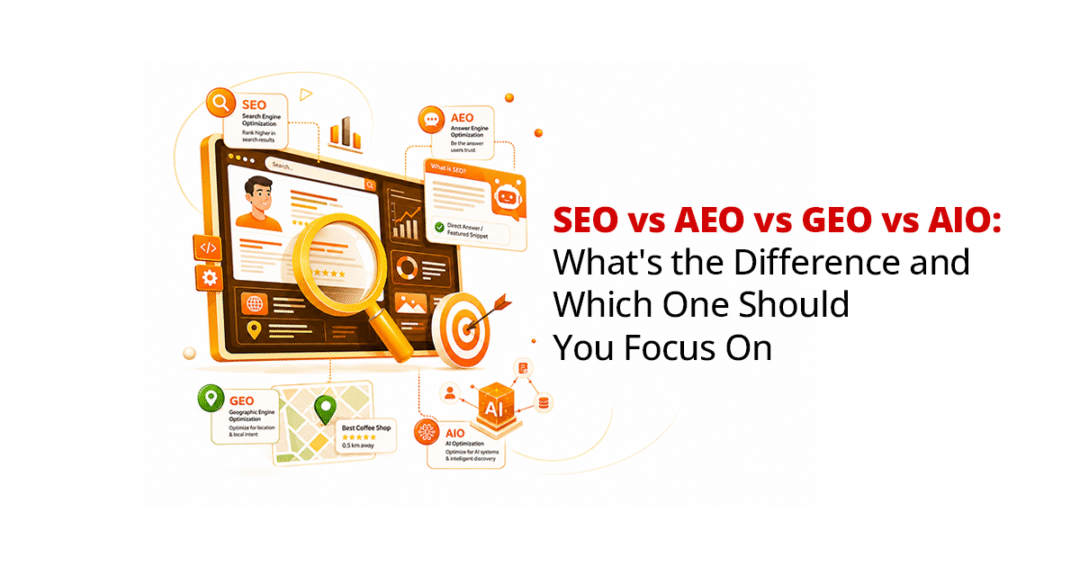
Search has changed more in the past two years than in the previous decade. SEO vs AEO vs GEO vs AIO, all these four acronyms now sit at the centre of every serious digital marketing conversation. Yet most brands are still optimising for a search landscape that no longer exists. If your digital marketing content strategy is built entirely on traditional SEO, you’re likely to optimise the traffic, leads, and revenue on the table.
Let’s break down each approach and help you figure out where your brand should be investing right now.
The Shift That Changed Everything
Not long ago, a brand’s entire organic strategy revolved around one question: “How do we rank on Google’s first page?”
That question hasn’t become irrelevant, but it’s no longer the only question that matters. Today, a user searching for “best project management software for startups” might:
- Get a direct AI-generated answer from Google’s AI Overview without clicking any link
- Ask ChatGPT and receive a recommendation that cites three specific tools
- Query Perplexity and get a sourced summary from five authoritative publications
- Use voice search and hear a spoken answer
Each of these scenarios requires a different Optimization strategy. That’s why understanding SEO, AEO, GEO, and AIO and how they work together is now foundational to digital growth.
What Is SEO (Search Engine Optimization)?
SEO (Search Engine Optimization) is the practice of improving and maintaining a website’s visibility and ranking in traditional search engine results pages (SERPs) through technical improvements, on-page content and off-page Optimization and authority building.
SEO is built on three core pillars:
- Technical SEO: From site speed, crawlability, indexation, Core Web Vitals, to mobile responsiveness, structured data markup, and site architecture, all come under the technical SEO. If search engines can’t efficiently crawl and understand your site, nothing else matters.
- On-Page SEO: Keyword research, content depth, heading structures (H1–H4), meta titles and descriptions, internal linking, image Optimization, and semantic relevance. On-page SEO is all about optimising these elements. It focuses on making each page maximally relevant for its target queries and searches.
- Off-Page SEO: It includes backlink acquisition, digital PR, brand mentions, and authority signals that tell search engines about your website’s credibility and ranking worth across the search engines.
- Where SEO still wins: Traditional SEO remains essential when a user actively clicks through to read, compare, and evaluate options for high-volume informational and commercial queries. But the E-commerce category pages, service-based landing pages, and long-form guides still rely on traditional ranking signals.
The limitation: SEO was designed for a world where users click blue links. Increasingly, they don’t.
What Is AEO (Answer Engine Optimization)?
AEO (Answer Engine Optimization) is the practice of tailoring content so that search engines and AI systems can extract and directly display your answers in featured snippets, People Also Ask boxes, voice search results, and position-zero placements.
The key insight behind AEO is that Google has become an answer engine. It doesn’t just want to show you pages that might contain an answer. It wants to give you the answer directly, on the results page itself, without any scrolling further.
How AEO differs from SEO:
| SEO | AEO | |
| Goal | Rank high in SERPs | Become the direct answer |
| Format | Long-form, comprehensive pages | Concise, structured Q&A content |
| Metric | Click-through rate, organic sessions | Featured snippet captures, voice share |
| Winner | The page with the most authority | The page with the clearest, most structured answer |
AEO tactics that work:
- Structured data markup (FAQ, HowTo questions and Q&A schema) helps Google identify and extract your answers easily.
- Inverted pyramid writing answers the question in the first sentence, then elaborates.
- Conversational long-tail queries: optimise for how people actually speak and ask questions.
- Consistent NAP and factual accuracy answer engines penalise outdated or inaccurate responses.
Where AEO wins: AEO helps you stay ahead in the voice search, featured snippets, knowledge panels, and local queries. If someone asks Google Assistant or Gemini, “What’s the best digital marketing agency in Mumbai?”, AEO determines whether your brand gets spoken aloud.
What Is GEO (Generative Engine Optimization)?
GEO (Generative Engine Optimization) is the emerging discipline of optimising your content and brand presence to be cited, referenced, and recommended by AI-powered generative search engines, including Google’s AI Overviews, Perplexity, and Microsoft Copilot in Bing.
Unlike SEO, which is about ranking links, GEO is about being included in AI-generated responses. When a user asks Perplexity, “How does content marketing drive B2B leads?”, the AI assembles an answer by pulling from multiple authoritative sources. GEO is the discipline of making sure your content is one of those sources.
What makes content GEO-optimised?
- Citability: When your content is clear, well-attributed, and factually precise, it allows AI systems to feel confident in referencing it ahead of time in the search.
- Topical depth: Covering a subject comprehensively enough that AI models consider you an authoritative source across related queries.
- Structured information: Statistics, step-by-step processes, and comparison tables are highly citable in formats on search engine platforms.
- E-E-A-T signals: Google still evaluates the author credentials, publication dates, expert quotes, and trust signals with AI systems to evaluate source quality.
- Consistent brand mentions: If your brand is being cited across multiple reputable third-party sources, it trains AI systems to associate your brand with a topic and maintain its ranking on the search engines.
Where GEO wins: On AI-powered searches (Perplexity, ChatGPT with Browsing, Google AI Overviews, Copilot), GEO ranks the most.
What Is AIO (Artificial Intelligence Optimization)?
AIO (Artificial Intelligence Optimization) is the broadest of the four frameworks. It refers to optimising your entire digital presence content, brand signals, structured data, and online reputation to be understood, trusted, and recommended by large language models (LLMs) and AI systems across all platforms.
AIO goes beyond individual search queries. It encompasses:
- Training data presence: How well-represented your brand is in the data that AI models were trained on
- LLM citation patterns: Whether ChatGPT, Claude, or Gemini should refer to your brand when answering questions in your category
- Multi-platform authority: Presence on Wikipedia, LinkedIn, Crunchbase, industry directories, and reputable media outlets that AI models heavily weight
- Knowledge Graph Optimization: Ensure your entity (brand, people, products) is clearly defined and disambiguated in Google’s Knowledge Graph.
- Reputation consistency: AI systems synthesise brand signals from reviews, press mentions, social proof, and user-generated content. Inconsistency creates distrust.
Where AIO wins: When a potential customer asks ChatGPT, “Which digital marketing agencies in India have strong SEO and performance marketing capabilities?”, AIO determines whether your agency name appears in the response at all, independent of whether you’re ranking on Google.
How SEO, AEO, GEO, and AIO Interact
A brand with strong AIO has built enough authority that AI systems can trust and refer it to the audience searching. That authority amplifies GEO by making your content more citable across search engines. And strong GEO reinforces AEO by establishing your content as the go-to structured answer for the related queries people search for.
Practical example: A fintech brand optimising for “best investment apps for young Indians” would:
- Use SEO to rank the comparison page with strong backlinks and on-page Optimization
- Use AEO to structure the page with clear schema markup and concise answers that Google can extract
- Use GEO to ensure the article is comprehensive, well-cited, and formatted for AI systems to reference in generative responses.
- Use AIO to build Wikipedia entries, earn press coverage, and establish the brand’s entity across knowledge bases so LLMs recognise it as authoritative.
Which Framework Should You Prioritise in 2026?
The honest answer depends on where your audience is in their search journey and which platforms they use.
Prioritise SEO if: You operate in a vertical where users still click through (e-commerce, local services, detailed comparison content). Traditional search intent still dominates in India for transactional and local queries.
Prioritise AEO if: You’re in a category with high question-based search volume, healthcare, finance, education, legal, and how-to content all have massive featured snippet and voice search opportunities.
Prioritise GEO if: Your buyers are sophisticated and research-first decision-makers who use Perplexity and ChatGPT to shortlist options before visiting websites. This is now standard behaviour for B2B SaaS buyers, tech professionals, and premium service purchasers.
Prioritise AIO if: You’re building a brand for the long term. LLM training cycles mean that brand authority built today shapes how AI systems represent your brand for years. The window to establish “founding authority” in AI’s understanding of your category is narrow and closing.
The pragmatic 2026 recommendation: An integrated SEO + GEO + AEO strategy executed simultaneously, with AIO as the long-term brand investment. Brands that are inconsiderate and treat these as silos will find themselves invisible in one or more of the increasingly fragmented discovery channels their buyers use.
Key Differences at a Glance:
| Dimension | SEO | AEO | GEO | AIO |
| Target platform | Google, Bing SERPs | Featured snippets, voice, PAA | AI Overviews, Perplexity, Copilot | All AI systems and LLMs |
| Content goal | Rank pages | Provide direct answers | Be cited by AI | Be understood as an authority |
| Primary metric | Organic sessions | Snippet capture rate | AI citation frequency | LLM brand recommendation rate |
| Time to results | 3–12 months | 1–4 months | 3–9 months | 12–36 months |
| Difficulty | High | Medium | Medium-High | Very High |
| Still essential? | Yes | Yes | Yes rapidly growing | Yes long-term play |
Final Thoughts
The searching landscape in 2026 is not one channel; it’s all these simultaneously operating discovery surfaces, each with its own rules. The brands that will win organic visibility over the next five years are those that build a unified strategy across SEO, AEO, GEO, and AIO rather than betting exclusively on any one.
Begin by analysing where your target audience can actually discover your brand in your category. Then build the content, technical infrastructure, and brand authority signals that each relevant channel requires.
Understanding the full spectrum of SEO vs AEO vs GEO vs AIO is the strategic foundation for staying visible, as the very nature of search engines continues to evolve.
FAQs
1. What is the difference between SEO and GEO?
SEO specifically focuses only on ranking your web pages in traditional search results, to optimise every user click. GEO focuses on making your content citable and trustworthy enough that AI-powered search engines (like Google’s AI Overviews and Perplexity) use it as a reference in their generated responses, often without a user clicking at all.
2. Is AEO the same as voice search Optimization?
AEO and voice search overlap significantly but aren’t identical. AEO broadly covers all forms of direct answer extraction and featured snippets, People Also Ask boxes, knowledge panels, and voice search results. Voice search Optimization is a subset of AEO that specifically focuses on spoken queries and smart speaker answers.
3. Does AI search replace Google SEO?
Not entirely, at least not yet. Traditional Google SEO still drives the majority of organic traffic for most businesses in India. However, AI search is growing rapidly, especially for research-phase queries. Brands can optimise both with a smart strategy rather than abandoning SEO in favour of AI-only Optimization.
4. How do I know if my content is GEO-ready?
Test it by asking Perplexity or ChatGPT a question your target audience would ask in your category. Check whether your brand or content is cited in the response. If it isn’t, you have a GEO gap; your content likely needs more depth, better citations, stronger topical authority, or more structured formatting.
5. What does AIO stand for in marketing? AIO stands for Artificial Intelligence Optimization, the practice of building your brand’s authority, structured data, and digital presence in ways that make AI systems across all platforms (not just search engines) recognise, trust, and recommend your brand accurately.